(8th Feb – 1st March, Midrand, South Africa)
- Lajana Manandhar
Arriving Midrand, South Africa
I arrived Protea Hotel in Midrand (South Africa) on 27th afternoon. This is the hotel that UNDP has booked for me to stay during my stay in Midrand from 27th Feb to 1st March for a global consultation on governance for post MDGs that is going to take place in Pan African Parliament in Midrand. I have been invited by UNDP to participate in the meeting. Getting to the Protea hotel from OR Tango international airport was not difficult. I had taken Gautrain from the airport, changed at Marlboro for Midrand. Gautrain bus service was available from Midrand station to the Protea hotel. I found this train service very easy, fast and convenient to travel. Also enjoyed watching beautiful landscape of this region from the train.
Early registration for the meeting was arranged in the hotel for theparticipants who were staying there. Soon after check in, I gotregistered, collected the conference bag and went to the room. I was tired as I was transit in Dubai a night before and could not also sleep in the plane. I checked emails in my mobile phone and straight went to sleep.
Global thematic consultation begins
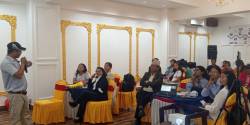
On 28th morning the bus from the hotel left around 8.15 am for the meeting venue, Pan African Parliament. We arrived there just before 9 am. The meeting started around 9.30 am. I think this was first international and UN meeting that I have participated that was not sticking with the programme schedule that have been provided t us.
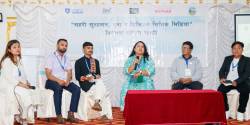
The first session had 6 panelists to speak. Two women from India and 4 men from different countries. The facilitator did not introduce the speakers properly and when they spoke, I did not have any clue about their work and background information. Little detail introduction was given later after the participants asked for it. The two women speakers, Devaki Jain and Aruna Roy, were great speakers. Aruna Roy was an activist based in Rajasthan and advocating / campaigning to establish people’s right to information. Devaki Jain, a feminist economist and a leader, had worked for UN, international agencies, and government of India on various development initiatives. The other speakers were ambassadors, archbishop and an advisor to the President of Liberia. And at least three of them spoke in Spanish, which was simultaneously translated in English.
I was spellbound to hear Devaki Jain. She clearly said she is not in favor of UN providing (rather imposing !) MDGs ( goals ) for us, for the southern countries. The goals must have come from within (the nations / people). She has never attended any meetings on MDGs prior to coming to this meeting. She accepted this invitation mainly because the meeting is in South Africa, which she regards her second home. Besides, she also wanted to share own thoughts. She also emphasized on economic democracy which she thinks is crucial for removal of poverty and recommended that post MDGs need to attack on inequality and focus on economic freedom as promoted by Gandhi. She was also concerned about the neglect of women and women’s movement and added that feminist knowledge can redirect development agenda.
Devaki Jain is 80 years old and she told me later that she has visited 93 countries. Imagine the knowledge, experience and intellect she carries and the ‘confidence’ to speak loudly disapproving the UN’s work in the presence of more than 200 high profile participants in the UN and OCHRC jointly organized “Global Thematic Consultation on Governance and the Post-2015 Development Agenda”. She was the first person I heard who has a different opinion on the current UN development initiatives.
The participants were allowed to ask questions to the presenters after all of the 6 panelists had spoken. I had a question for Devaki Jain. What goals would the governments have had if there were no MDGs ? Given the context of corruption and weak governance in the governments, was it possible that they had worked on better goals than MDGs , if MDGs were not there? Her reply to my question was not very clear. May be she had too many questions to answer. She said the agenda (goals) should be set or decided by the people’s uprising. I am still not comfortable with this answer. Later a guy came and asked me for more explanation on my question. He introduced himself as an advisor to one of the member of high level committee.
Aruna Roy spoke about her work rather a struggle to bring Right to Information Act in India and a continued battle with the government as in every 6 months government starts a process to make amendment in RTI. Archbishop spoke about his concerns on loss of spirituality and morality and disregards for human lives due to the war and famine. He emphasized on the need to deal with corruption, accountability, transparency and to work with the young people. The other speakers also highlighted the need to give value to ‘human values’ , which seem to be loosing giving high value to ‘monetary value’.
Highlights from the plenary discussion
The plenary discussion made highlights on the following:
•What have we done wrong in the past, if we are saying to do the things in a different way?
•People have ideas for development. Development must be OF, FOR and BY people.
•US/Europe has vested interest. They have taken natural resource away.
•The concerns/recommendations of national high level commissions / panels not heard but MDGs are responded.
•The concept of civil society has not included trade unions.
•Need to systematically question the elected leaders.
•Political will for delivering opportunities for post MDGs is very important.
•Multi stakeholders monitoring committee must be established to monitor the progress of country level goals. Measurable monitoring indicator is important.
•Corruption is like a cancer in Africa. Post MDGs must address corruption.
•The mortality of women is high and youth are unemployed.
•Democratic government with a human right principle is a must.
Welcome message
Helen Clark, Administrator, UNDP and NavilPillay, Human Rights Offier, OHCHR readtheir welcome message through video. They also highlighted that the post MDGs will be a next step to realize incomplete goals and to work on a better future for all. Helen Clark also mentioned that ‘governance’ has been ranked as second most important issue by the people from around the world in ‘My world survey’.
Meeting former chief secretary of Nepal
During the tea break, the former chief secretary MadhavGhimire came and spoke to me. Earlier in the plenary, before I spoke I had introduced myself as Nepali. This must have prompted him to speak to me. I told him bit more about myself and Lumanti. I was so naïve. I did not know him as I had not met him before. I humbly asked for his introduction. Introducing himself, he said that he had heard about myself and Lumanti. I realized he was the then chief secretary when the infamous forced eviction had taken place in Thapathali, Kathmandu that had made 165 families homeless.
Identifying key areas and themes of governance in the post 2014 development framework
Four panelists presented their views on the issues that need to be addressed in the post 2015 development framework. The key emerging issues that need serious attention in future were as follows.
•Sustaining peace
•Tailoring the Global Goals to national reality
•Delivery of quality service (not only increasing quantity)
•Consistent development on the basis of maximum resource available in the country
•Universal review mechanism for tracking progress of product and process
•Inclusive, accountable, transparent and responsive government
•Empowerment of civil societies and participation of those in decision making whose lives are to be affected
•Realisation of all human rights
•Global and national level income disparity and socio-economic inequality
•Strong representation and participation of youth
Watching a scene of police brutality
Before retiring to bed, in the late evening on 28th Feb, I put TV on. As I was unaware of the local TV channels in South Africa, I was just flipping the remote control and suddenly stopped to listen and watch the scene of police brutality that had taken place in Johannesburg on that afternoon. A taxi driver had parked his taxi in a wrong place. The police spotted him. Few police beat him hard and used force to put him in a police vehicle. Taxi driver had not gone inside the vehicle and got hold of the back door. Suddenly the police vehicle moved dragging the taxi driver on the road. There were people, men, women and children standing and watching this act of the police. Nobody dared to speak and shout. I had watched a terrifying incident. Then the vehicle stopped and the taxi driver was forcefully pushed inside the vehicle. Two hours later, he was found dead. A local woman, who had witnessed the incident, told media, “how can I tell my children that police did this, the police who are supposed to protect us?”
Next day, I was happy to hear one of the participants speaking about this incident in the plenary session. Police brutality (in the world) is indeed an issue highly linked with the governance, that we all have been thinking and brain storming to find solutions on making the governance a democratic and responsive to human rights.
Positioning governance in the post 2015 agenda
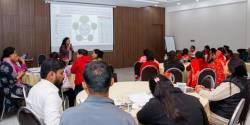
Next day, again four panelists made presentations and spoke about their views in positioning governance in the post 2015 agenda. The highlights were:
•Democratic values like rule of law, effective public institutions, respect for human lives and participation of the poor is important in democratic government.
•Civil society participation in inter governmental consultations is important.
•Regional alliances and unity among different institutions and countries is important for a well functioning mechanism.
•“Bring your measuring stick”. Indicators need to be simple for measuring.
Although all the presenters spoke about important governance issues, but at times I felt that … oh … yea ..how will this be realized in the poor vulnerable and marginalized communities! As I listen to the speakers and the participants making comments and expressing their views, the picture of the lives of the slum dwellers, their struggle to exercise their rights to access basic facilities such as housing, water, sanitation, employment and the forced eviction (from the government) that had happened few months back in Kathmandu, were reeling like a movie before my eyes. I was not alone, the other participants representing the slum communities Ofelia from Philippines and Maria from Bolivia had also felt in a similar way that I did.
I was boiling to speak out with my hand raised, and finally I got the ‘go’ signal from the moderator. The government is also people. But the people in the government do not have empathy towards the poor. This is what we see lacking among the people in the government. When we talk abut the measuring the progress, it is equally important to see what is going to be measured, who will do it, how it will be done and when it will happen. As there was also a talk on demonstration, movement and popular risings, I had wondered if it would be possible to achieve the goals without poor people getting on the street! Its never been easy for the people, especially the poor, going for days and months long rallies and strikes to get their rights / demand fulfilled. The duty of the responsive government is to make response to the people’s need and demand without giving trouble to the people. I must have spoke with passion on these lines, as I alsoreceived some appreciation for my passionate comment.
Remarks of GracaMachel
GracaMachel, one of the members of the High-level Panel on Post-2015 Development Agenda, spoke on the likely framework of post 2015 agenda in the concluding session. She was clear, spoke from her heart and I found her very inspiring. Her key remarks were as follows:
•MDGs focused on goals and targets (good!) for the poor but narrowed our focus
•The panel is thinking to present the AGENDA and not goals for future development. It will be the Universal Agenda that is for all of us
•The future agenda will also look at the changing demography of the world such as a large population of youth, growing number of old people, stronger feminist views and unequal relationships (among the states)
•A need to end poverty in all its forms by 2030. This requires gradual building of prosperity with respect to human right principles.
•We need to change our mentality and attitude to make change.
•The MDGs debate and consultations need to be taken down to our constituencies and continued beyond 2015. Recommendations for future development agenda can sent at secretariat@post2015hlp.org
Closing the two day long meeting, the facilitator said that all the contributions made will be taken into account and a report will be submitted to the UN General Secretary General. But in the end, it is again the member states who will be endorsing the final agenda.
Departing South Africa
Unexpectedly departing South Africa has become a memorable story. We had booked a vehicle from the Protea Hotel to go to the airport. Four of us, Rajiv Malhotraand RanjaSen Gupta from India, GabrielaKnaulfrom Brazil and myself had decided to go together to the airport as all of us were departing almost at the same time, and all three ladies taking the same flight to Dubai. It seemed that there was some confusion in arranging the vehicle. The driver seemed to be confused about the direction to the airport and quite upset with the frequent phone calls that he was receiving from his boss. And the road to the airport !it’s a highway with multiple tracks!! Talking over the phone and driving certainly was not a safer thing to do in a highway. Rajiv had to take control of the driver’s mobile and kept on responding the phone calls. The boss also seemed to be curious about the route we had taken. The driver tried to changed the track and oh! My god, we nearly had an accident. Rajiv constantly kept talking to him, trying to cool his temper and helping to stay on the right track following the directions on the road to the airport. Never before I had such a scary experience. After getting off from the vehicle at the airport, Gabriela said“I was so afraid”. She is the UN Special Rapporteur on Independence of Judges and Lawyers. Rajiv had handled the situation in a perfect manner for about an hour long driving. We all are thankful to him. Thank God !
Reflecting on the meeting
After settling in my seat on the Qatar Airways flight from Johannesburg to Dubai, I started reflecting on the meeting. I was very glad to make to this meeting. The presentations and discussions were quite enriching and very useful. I had heard and met few very inspiring women and among them I will always remember Devaki Jain, Aruna Roy and GracaMachel, for their intellect, confidence, dedication and an ability to inspire the younger generation of women like myself.
I end this blog with a special note of thanks to Katia and Huairou Commission for nominating me to participate at this global consultation on governance and the post 2015 development agenda.