
Water, Sanitation and Hygiene

Water, Sanitation and Hygiene
For more than three decades, Lumanti has worked to improve access to safe water, sanitation and hygiene (WASH) services among poor, low-income and marginalised communities, particularly in urban and peri-urban areas of Nepal. The WASH intervention combines community-led action, infrastructure development, institutional strengthening, rights-based advocacy, and engagement with local governments and service providers.
Lumanti works in partnership with local governments, community-based organisations, user groups and other stakeholders to identify WASH needs, develop locally appropriate solutions, and support the construction and management of essential infrastructure. Alongside service delivery, Lumanti promotes community participation and advocacy so that poor and marginalised communities can claim their rights and influence decisions affecting WASH services.
Over the years, this approach has also helped strengthen partnerships between communities, local governments and service providers, encouraging greater public investment and more responsive WASH services for low-income communities.
Initial Interventions in WASH
Soon after its establishment in 1994, Lumanti initiated its WASH programme in informal and low-income settlements of Lalitpur. Its first intervention was in Lonhla, a settlement of the Khadgi community, where Lumanti supported the construction of a sewerage line that enabled households to construct toilets and helped eliminate open defecation. A similar approach was later implemented in Khapinchhe and other settlements.
In Kathmandu, Lumanti supported informal settlements to gain access to basic water and sanitation services. In Balaju, Lumanti acted as a guarantor to the then Nepal Water Supply Corporation to facilitate the extension of a drinking water pipeline to the settlement, making it one of the first informal settlements in Kathmandu to receive piped water supply. The approach was subsequently replicated in other settlements. Lumanti also supported the construction of household and shared toilets.
In Khadipakha, Lumanti supported the development of a decentralised wastewater management system, providing a small-scale solution for treating domestic wastewater and safely discharging treated water. The initiative demonstrated the potential of locally managed and decentralised approaches to addressing urban sanitation challenges.
Influencing Urban Water Services and Policies
Lumanti's WASH work has extended beyond community-level infrastructure to influence systems and policies governing urban water services. During the restructuring of the water sector in Kathmandu Valley, Lumanti actively advocated through the NGO Forum for Urban Water and Sanitation for improved access to piped water for informal settlements and low-income communities.
This advocacy contributed to the establishment of the Low Income Consumer Support Unit (LICSU) within Kathmandu Upatyaka Khanepani Limited (KUKL), with a mandate to address water-service concerns of low-income consumers. Providing services to low-income communities was also incorporated as a performance indicator for the service provider.
Recognising that extending pipelines to all underserved communities would take time, Lumanti conducted a study identifying 100 low-income communities across Kathmandu, Lalitpur and Bhaktapur requiring improved water services. The findings contributed to KUKL initiating tanker water services to these communities as an interim measure.
Lumanti also represented civil society on the Kathmandu Valley Water Supply Management Board (KVWSMB) for approximately 15 years, contributing community perspectives to discussions on urban water governance and service delivery.
Supporting Community-Managed Water Systems
Lumanti has supported the development of community-managed water systems in partnership with local institutions and user groups. In Tokha, Lumanti provided financial and technical support for the establishment of the Tokha Brihat Khanepani Tatha Sarsafai Upabhokta Samiti and the development of a piped drinking water system. The system has grown into a successful community-managed service serving more than 1,000 households.
Lumanti has also supported the conservation and rehabilitation of traditional water sources and water-related heritage. In Sano Khokana, Lalitpur, it supported the conservation of seven or more ponds to contribute to groundwater recharge, alongside street paving and promotion of household toilets. In Siddhipur, Lumanti supported the conservation of a heritage stone spout, restoration of water facilities at a traditional mourning place, and conservation of a traditional garden and pond.
These interventions demonstrate Lumanti's approach of linking modern WASH services with the conservation of traditional water systems and locally rooted practices.
WASH in Emergencies and Crisis Response
Lumanti has also mobilised its WASH expertise during emergencies and crises. Following the 2015 earthquake and during the COVID-19 pandemic, Lumanti supported communities in Kathmandu and Lalitpur with emergency WASH services.
The response included installation of handwashing stations, construction of temporary and permanent toilets, distribution of hygiene kits, tanker water supply, hygiene promotion and online hygiene consultations. These experiences have strengthened Lumanti's capacity to deliver rapid WASH support while incorporating disaster risk reduction and resilience considerations into longer-term programming.
Technical Expertise
Over three decades of engagement, Lumanti has developed expertise across the full WASH cycle from community needs assessment and infrastructure development to governance, advocacy, research and knowledge sharing.
Lumanti possesses comprehensive expertise in the planning, design, construction, and management of varied WASH infrastructure. This encompasses household and shared sanitation facilities, drinking water distribution systems including taps, hand pumps, and piped networks, municipal and community-scale water supply infrastructure, decentralized wastewater treatment mechanisms, natural water resources such as ponds, wells, and irrigation channels, conventional water delivery structures including heritage stone conduits and analogous traditional systems, sanitation and hygiene facilities within educational and healthcare institutions, stormwater management systems integrated with road construction initiatives, and emergency and disaster-response water, sanitation, and hygiene infrastructure.
Lumanti has also promoted innovative and sustainable approaches, including ECOSAN toilets, SODIS, communal waste-to-biogas systems, decentralised wastewater treatment, and climate-resilient WASH solutions, adapting technologies to local needs and capacities.
Community-Led WASH Planning and Governance
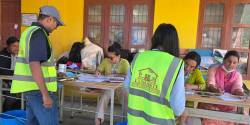
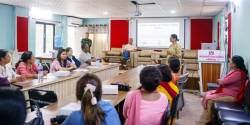
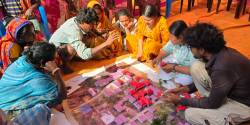
Community participation is central to Lumanti's WASH approach. The organisation facilitates communities to participate throughout the WASH project cycle from needs identification and planning to implementation, operation and maintenance.
Lumanti has supported the formation and strengthening of water and sanitation user committees, cooperatives, community-based organisations and citizen forums, with an emphasis on inclusive decision-making, transparency, accountability and sustainability.
Particular attention is given to ensuring the participation and leadership of women, low-income households, informal settlers and other marginalised groups in WASH planning and management.
 |
 |
Rights-Based WASH Advocacy
Lumanti views access to water and sanitation as a fundamental right and has worked to strengthen the policy and institutional environment necessary to realise this right.
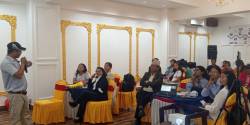
The organisation contributed to advocacy during the drafting of the Constitution of Nepal, supporting the recognition of the right to water and sanitation as a fundamental right. Lumanti has also contributed to national and regional WASH policy processes through its engagement in sector forums, including the Joint Sector Review (JSR) and South Asian Conference on Sanitation (SACOSAN) processes.
Through these engagements, Lumanti has highlighted the WASH challenges faced by low-income and marginalised communities and advocated for inclusive policies, responsive services and effective implementation towards Sustainable Development Goal 6 (SDG 6).
Connecting Local Practice with National and Global Learning
Lumanti brings community experiences and locally generated evidence to national, regional and global WASH platforms. Through participation in networks and platforms such as Sanitation and Water for All (SWA), Butterfly Effect and Fresh Action Network South Asia (FANSA), Lumanti has shared experiences, innovations and lessons from community-led WASH initiatives. Lumanti is currently hosting FANSA as the secretariat.
These engagements have created opportunities for South-South learning, knowledge exchange and dialogue on inclusive and pro-poor WASH services, while also enabling Lumanti to bring wider sector learning back into its programmes in Nepal.
News & Events
Share News:
-
Call Us
-
Email
-
Address