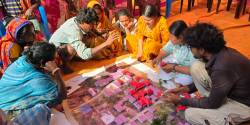
Before entering the field of micro financing, I was oblivious to just how marginalized women in impoverished conditions really were. Like most outsiders, I presumed that poverty was pervasive across all demographics and that women like their male counterparts, succumbed to poverty for the same reasons. The intricacies of poverty are murky to say the least with very little correlation explaining why poverty corrodes various sectors of life. At ones first glance, it may seem like the topic of poverty alleviation is to convoluted to create a solution that helps a wide variety of impoverished residents. Through working withLumanti, I have slowly learned about the importance of micro financing and about how this economic tool can transform vulnerable communities.
Furthermore, I have realized that the funding of impoverished women has the prospectus of not only empowering this heavily disenfranchised demographic but has the potential of enhancing a communities livelihood.
At its inception, micro financing has targeted women living in low-income positions. Adherent experts to the micro financing philosophy site the essentiality of partnering with impoverished women due to their inherent desires to promote a better life for their families and communities. A disproportionate percentage of families living in poverty are single-mother households or are households where a supporting husband is non-existent. In such cases, women are seen as the head of the household and the main contributor to the family’s household. Through lending directly to women and providing services for woman only, there is great hope that this marginalized segment will invest accordingly and persevere through economic hardships to support their families.
Working with micro financing has been eye opening to say the least. I’m constantly grappling with my own ideals and my perspectives are in a constant state of flux. Before becoming immersed in the field of micro financing, I perceived poverty to be ubiquitous among all who suffered through its malevolent fury. I never realized just how dichotomous life was for those living in these desperate conditions. Through my work, I’ve had countless conversations with women who are the head of their respected households due to their husbands shunning the family or leaving the household for venal desires. In many cases, these mothers have no economic power, have very little working experience and are constantly struggling to feed their families. These women may poses very little in financial capital but have a myriad of aspirations and entrepreneurial ideas. All they need are the assets to make these dreams reality.
What micro financing does to impoverished communities is that it identifies a specific segment of the population that strives for progressing the community’s livelihood. Since women in under-developed societies are inherently motivated to enhance the community for not only themselves but for their children, lending exclusively to this segment has the potential of increasing the livelihood in many insolvent areas. Furthermore, micro financing takes on a poverty alleviation tool overlooked by most organizations and charitable initiatives. By narrowing the mission to one specific population that has historically been disenfranchised or shunned by major aid projects, there is great belief that this group will be receptive to their newfound empowerment and slowly spur economic prosperity in their respected communities.
Women are the focal point of impoverished communities. They are the ones seen tirelessly working at progressing the family and in turn the neighborhood. Through catering explicitly to this unheeded group with inexorably good intentions, there is tremendous hope that women with financial power will do what’s best for their own families; thus their own communities. Micro financing is a nuanced measure that has started to gain traction in much of the developing world. Through working with this prevalent phenomena, I have acquire a new perspective on the importance of lending to neighborhoods of destitute specifically lending to a communities female populations as these are the leaders of the community.
Written By: Ben Conner, Volunteer
Written By: Ben Conner, Volunteer