Translated into English, the name ‘Sambeshi Tole’ means ‘Inclusive Community’. Located in Nepal, adjacent to one of Pokhara’s primary transport connections, and home to 75 families of diverse ethnic, caste and geographical roots, this Reall community certainly lives up to its name.
“Though the community consists of different ethnic, class and caste groups we are all living here in harmony. I am happy because there is no discrimination or conflict and we all come together in social activities such as community construction and cleaning.” – Pramela Banjara, 22, Sambeshi Tole resident.
The homes in Sambeshi Tole have been specifically designed to maximise the potential of a heavily constrained site in Pokhara. Occupying a small plot adjacent to one of Pokhara’s primary transport arteries, and bounded on one side by the Bijayapur River, a combination of contextual constraints and favourable planning policies drove Reall’s partner in Nepal, LUMANTI, to experiment with incremental verticality.
The original floor-plan of each home provides families with three rooms, together with a private bathroom. These homes are arranged in tight-rows of semi-detached, ‘duplex’ units, offering the neighbourhood a distinct urban scale. Two-thirds of the original structure is completed with a flat, concrete roof, providing residents with additional outside space in the short-term, and a firm platform upon which to build additional rooms in the long-term. The front third of the home, initially covered by a sheet of blue painted corrugated iron, is also structurally designed to support vertical expansion in the future. Once completed in line with the detailed architectural plans, each home will comprise six rooms.
Building at a higher density triggers a number of benefits for the resident community. First and foremost, in reducing the amount of land required to construct, it becomes financially viable for low-income communities to acquire homes closer to the city centre. This is hugely advantageous when considering quality of life indicators such as proximity to livelihoods and availability of public transport connections and municipal services. Secondly, the construction of a tightly packed urban community also stimulates economic opportunities closer to home.
Throughout the site, several community members have converted their front-room into a small local enterprises. These ventures include a beauty parlour, two convenience stores, a water kiosk and a dairy product store. Such activities not only generate significant income, they also animate the street scene, and bring vibrancy to the community. On the whole these enterprises were financed by start-up loans distributed by the community’s own credit and savings group.
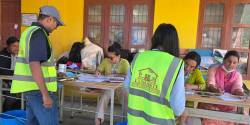
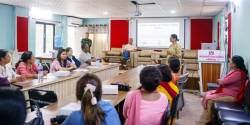
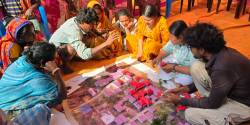
Comprised of 74 women and one man, this group contains a representative from every household within the scheme. Headed by an inspirational Chairlady, Til Kumari Thapa, the group is able to offer loans of up to 10,000 Nepali Rupees (£66) to aspiring entrepreneurs within the community. LUMANTI was instrumental in seed funding this group, and continue to nurture its capacity.
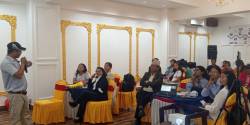
In addition to providing a resource for savings and credit, those community groups nurtured by LUMANTI also provide a source of collective power, allowing groups of poor women and men to assert their right to municipal services and support. Through this vehicle, the community at Sambeshi Tole have been able to negotiate a cost sharing agreement with their local government for the provision of high-level urban services such as storm drains and black-top road surfacing. Under the terms of this agreement, the municipality is committed to meet 80 percent of the project cost, on the condition that the community provide the remaining 20 percent up front.
Overall, the Sambeshi Tole project demonstrates that, where minimum plot-sizes allow, it is possible to deliver affordable, appropriately designed housing that can be extended incrementally in a vertical fashion. As inner-city land prices continue to inflate across the globe, this precedent represents one possible solution to ensuring that communities of the urban poor are not forced onto peripheral land as a result of affordability issues.
Case study written by: Tim Wickson (Research and Communications at Reall)
Source: http://reall.net/nepal-community-cs/